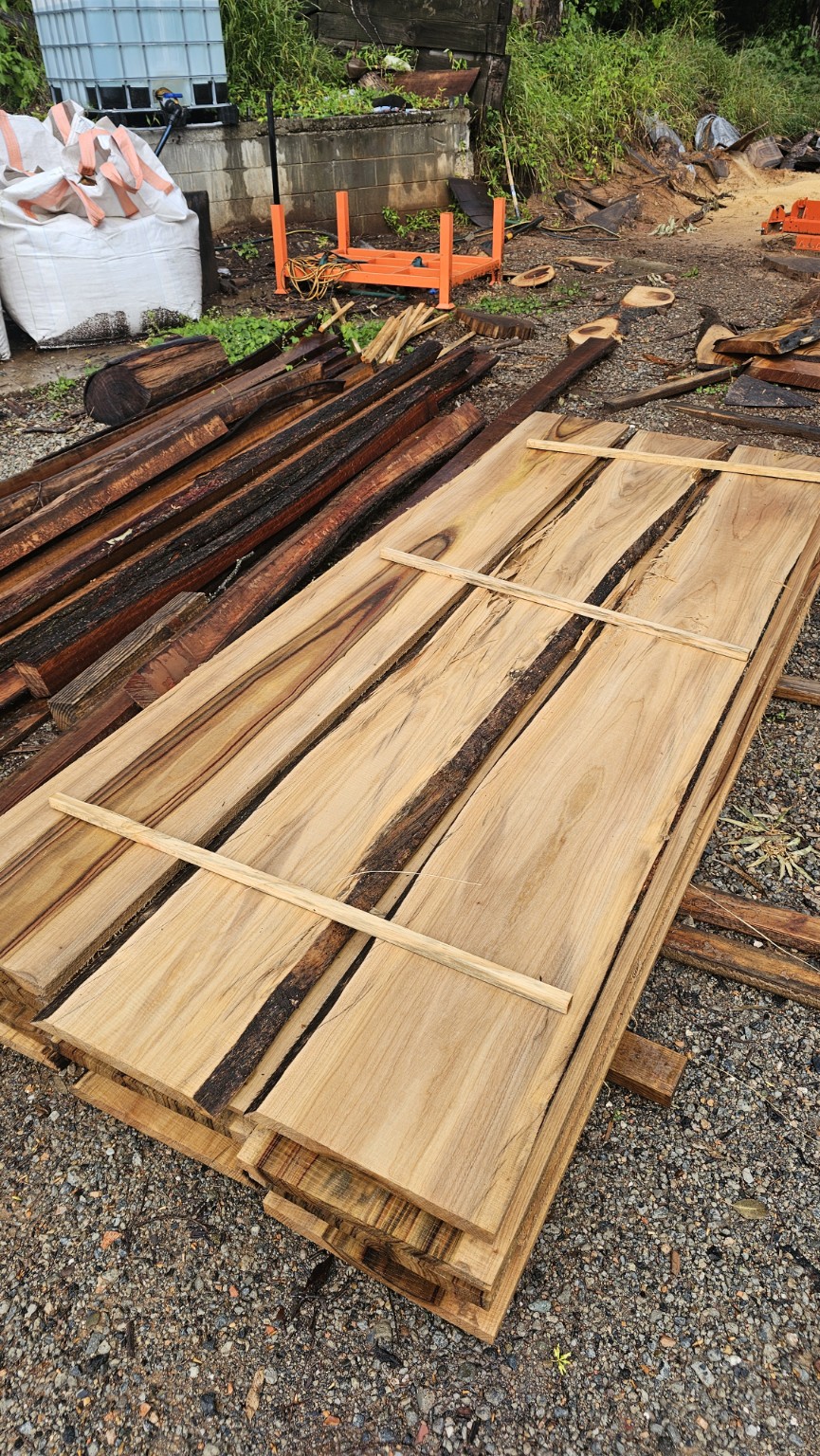
Some timber is chosen to blend in. Camphor laurel is often chosen for its character. For makers and trade buyers, the opportunity is to select boards that suit the design, then get the dimensions, drying and preparation right.
What is camphor laurel?
Camphor laurel (Cinnamomum camphora) is an introduced hardwood found in parts of Queensland and New South Wales. It is known for its distinctive camphor aroma and decorative timber. Its hardwood classification is a botanical description; it does not, by itself, establish suitability for a particular structural application.
At Creative Timber World, camphor laurel is part of our milling, processing and supply work. We discuss it with Australian trade customers and overseas buyers seeking logs or sawn timber.
Colour and grain worth selecting for
The timber can show warm honey tones, pale to mid browns and darker brown or reddish streaks. Its grain is commonly interlocked, with a moderately fine, even texture. These characteristics make board selection an important part of the finished appearance. [1]
For a feature piece, ask to see the actual boards. For a production run, agree on the acceptable colour range and natural features before ordering. A reference photograph is especially useful when several components need to look consistent together.
Where camphor laurel works well
Established uses include furniture, tables, shelving, cabinetry, turned objects and carving. It is also used for chopping and serving boards. [1]
Furniture & interior features
Start with the design: a broad feature surface, a set of matching components or a more uniform panel. Give us a cutting list and tell us which faces will remain visible.
Board-making & small products
Define the usable blank size and whether knots, cracks or other natural features are acceptable. For food-contact products, the maker should assess the timber, adhesive and finish for the intended use.
Turning & carving
Specify the blank dimensions and drying condition needed for your process. Tell us whether you prefer clear material or a more characterful piece.
For structural work, exposed outdoor applications or specialised environments, specify the performance requirements first. A species name alone is not a product specification.
A useful timber with a different sourcing story
Camphor laurel is native to Asia and has become invasive in parts of eastern Australia. It can compete with native vegetation and hinder regeneration. NSW government guidance recognises that suitable trees can be used as commercial timber, helping offset the cost of control. [2]
Our view is that making useful products from suitable logs recovered during planned removal gives the material a worthwhile next use. That story should be supported by the source of the actual timber. Ask about provenance and available records when specifying recovered material.
Tree removal is only one part of weed management. Follow-up control and appropriate replacement vegetation matter too. [2]
Drying matters as much as appearance
Timber exchanges moisture with its surroundings, and changes in moisture content can cause shrinkage or swelling. Seasoning should bring the material towards a condition suitable for its intended environment. Kiln drying does not make wood immune to later movement. [3]
For an interior project, tell us where the finished product will be used and ask about the moisture condition of the proposed supply. Allow the timber to adjust to the workshop or installation environment as appropriate, and design the finished piece to accommodate normal movement.
A rough-sawn board needs allowance for preparation. If you need a finished 30 mm component, do not assume a nominal 30 mm rough board will deliver it after flattening and dressing. Discuss the required allowance with your processor.
What to include in your timber enquiry
A useful quote starts with a clear brief. These details help us assess material for a one-off project or a repeat production order.
- Application. Tell us what you are making and where it will be used.
- Dimensions. Include finished thickness, width and length, plus whether you need straight edges or natural edges.
- Selection. State your requirements for colour, grain, knots, cracks and other natural features. For clear blanks, specify the defect-free area needed.
- Drying & preparation. Confirm whether you need green, air-dried or kiln-dried timber, your moisture target and any machining requirements.
- Quantity & timing. Provide piece counts or cubic metres, repeat usage if relevant, and your required delivery date.
- Destination. Include the delivery postcode or overseas port. For logs, add the required length and small-end diameter range.
For a repeat order, an agreed sample or written selection brief can make the conversation much more precise. Confirm available sizes, preparation, pricing and lead times with each quote.
Discuss camphor laurel supply with CTW
Creative Timber World is the timber division of JCorp Trading Pty Ltd, based at 629 Stanmore Road, Luscombe QLD 4207. Our operations include milling, kiln drying and processing camphor laurel, alongside wholesale timber supply and export enquiries.
Send your cutting list, target volume and delivery location. We will work through the available material and preparation for your order.
Enquire about camphor laurelPrefer to talk? Call John on +61 449 110 335.